
Showing posts with label Saudi Arabia. Show all posts
Showing posts with label Saudi Arabia. Show all posts
Monday, June 2, 2008
Stranger things...
Just a short entry today. I have been trying to find some traditional Saudi children's clothes for my sister's kids, but to no avail. I have asked several people and I always end up being directed to stores that sell blue jeans and "the Gap" t-shirts. This leads to the inevitable conclusion that the tradition clothing of Saudi Arabia consists of blue jeans and baby Gap. That, however, is only the frame of the story. During my meanderings in the market I saw a store that sold movies and music and decided to check it out. I really have only two interests when shopping: books, the older the better; and music. Everything else, like food, clothing, and deodorant, are optional and waste money that could more profitably be spent on books. As I wondered the much editted selection of the store, which consisted mostly of Bollywood movies and American pop albums with black marker covering up the women (Shakira's album was, in fact, completely blacked out), I saw the recently released movies. There was "Enchanted" in Arabic, lots of Hollywood and Bollywood fare and, most surprising of all -- so surprising, in fact, that I am tempted to return to the store, camera in hand, just to take a picture if I thought they would not chase me out for doing so -- was the complete "Work and the Glory" series. Who marketed that here?! The box did not say whether the movie was translated or even subtitled in Arabic, but there it was right on the "Hot New Releases" shelf. Weird. It is a small world afterall.

Wednesday, May 28, 2008
Small Miracles
 Today I ordered breakfast in bed. Yes, go ahead. Hate me. However, to "improve my Arabic" I turned on the TV, which has nearly 100 channels mostly in Arabic and English, but also in Urdu, French, Spanish, German, Japanese, and a few others. As I was flipping for something good, I suddenly saw Bryce Canyon and lo and behold a documentary was on the national parks of Utah in Arabic! More proof that Utah and Saudi Arabia have a lot in common. For more proof that Saudi Arabia is the Utah of the Middle East, just look at the pictures below, all of which are in Saudi Arabia.
 I stole these pictures from another website (sorry!), but until I get a chance to visit these places, this will have to do. Seriously though; a few Artic Circles, more snow (there is snow is the higher elevations of Saudi Arabia and indoor man-made snow resorts!), a few polygamists in the desert, oh wait...
Still, the scenery is beautiful, when it's not intensely hot. It was, I think, around 110 degrees. But its a dry heat.
Riyadh, city of Kings

Though the Arabian Peninsula has a long and storied history, first being mentioned in the Babylonian chronicles which complained of the bands of camel and horse riding warrior "Arabs" allied with their enemies, Riyadh is quite young and one of the oldest buildings dates only to 1856 or so. It is a fortress: Al-Masmak (picture at right). It is a giant, mudbrink structure built by the former rulers of Riyadh after the Saudi family had been driving out by a rival family and were in exile in Kuwait. In 1902, King Abdulaziz, founder of the modern state and father of King Faisal, the subject of my project, stormed the fortress and conquered Riyadh leading to a series of victories that ultimately led to the modern state of Saudi Arabia. In 1905, about the time of the of the early decisive victories, Faisal bin Abdulaziz was born. His name, which means (as the dicitionary puts) decisive criterion, was, according to some sources, named for this auspicious era (or for an ancestor).
This relative youth of Riyadh and the fact that it was built of mudbrick, means that much like the United States, Riyadh and much of Saudi was not burdened by the decaying or decayed remains of past civilizations, but has been able to build a modern city whose freeways and malls would not see out of place in LA or Las Vegas.
 This is a picture of the skyline seen from the Globe, a highrise restaurant cum observation deck in Faisaliyah, the skyscraper my hotel is located in. The tower in the picutre, Kingdom tower, anchors the other end of the main road, though there are plans to build a larger skyscraper between close to Faisaliyah.
I was able to see some of the city with my new boss's secretary who was asked to chaperon me through the night life. I am somewhat troubled by the kindness of Arabs, not because I suspect ulterior motives, but because I doubt my ability to be so generous in return. We Americans are a solitary bunch and even Utah, somewhat more communal than most of America, is nothing, in my experience, to social life of Arabs. It is overwhelming to me sometimes, but I kind of like once I get my feet wet.
 Here is a picture of some armor and weapons used in the battle to unify Saudi Arabia. Most of it is nineteenth century. It is a marvel that in less than one hundred years, Riyadh has transformed itself from a mudbrink regional capitol to a world city. You can see the contrast in this picture; chainmail, spears, sword, but at the same time they were using rifles and pistols. It was pragmatism. They used everything that had regardless of where or when it came from.
Tonight I was able to visit some of the nightlife of Riyadh-nothing exciting. With no movie theaters or clubs aloud, visiting the mall is, according to Raid, my guide to all things hip in Saudi, the major past time. He took me to a mall in Olaya, the fashionable part of north Riyadh and I was able to visit a books store, which sold everything from the complete sayings of Mohammad to the latest Ken Follett or Robin Cook novels. It also had a Starbucks and wireless hotspot. Very exotic.
I worry that in writing this, someone will either say, "You are pointing these out only because you had bigotted views about the backwardness and/or otherness of Saudi Arabia," or, "You are representing only how the westernized elite live, not the opressed majority." Both charges likely have some merit, but it is useless to deny that one has prejudices and expectations. That is part and parcel of the human thought process. In order to make decisions and avoid insanity, the brain creates categories and shortcuts to speed up decision making. Everyone has prejudices. Were it not so, you could not function because your mind would be constantly overwhelmed by every little detail. You would be, in other words, Autistic. It is interesting, therefore, to note that in some literature on Austism, researchers have pointed out that Autistics are less likely to be prejudiced; they are childlike in their openness to new information and hence overwhelmed by the minutiae of life.
 This is a picture of some of the rock art in Saudi Arabia (don't worry they're are lots more where this came from! The ubiquitious sandstone and rock art which its delicate arches, mesas, and sheer rock cliffs reminds me of Southern Utah quite a bit. I hope at some point to be able to visit.
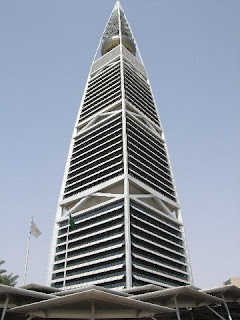 Finally, a picture of Faisaliyah Tower, my hotel is not visible as it is part of the lower complex that forms the base of the tower. The Globe, from which I took the aforementioned picture, is visible. It is primarily a restaurant with some stores. The complex also includes the King Faisal Foundation headquarters and the library/archives, though they are building new headquarters nearby that will have a place dedicated to the archives I am assisting with. There are also condominiums, offices, stores, a gallery and so on. The Faisaliyah is a major downtown landmark close to some of the major shopping districts.
This relative youth of Riyadh and the fact that it was built of mudbrick, means that much like the United States, Riyadh and much of Saudi was not burdened by the decaying or decayed remains of past civilizations, but has been able to build a modern city whose freeways and malls would not see out of place in LA or Las Vegas.
 This is a picture of the skyline seen from the Globe, a highrise restaurant cum observation deck in Faisaliyah, the skyscraper my hotel is located in. The tower in the picutre, Kingdom tower, anchors the other end of the main road, though there are plans to build a larger skyscraper between close to Faisaliyah.
I was able to see some of the city with my new boss's secretary who was asked to chaperon me through the night life. I am somewhat troubled by the kindness of Arabs, not because I suspect ulterior motives, but because I doubt my ability to be so generous in return. We Americans are a solitary bunch and even Utah, somewhat more communal than most of America, is nothing, in my experience, to social life of Arabs. It is overwhelming to me sometimes, but I kind of like once I get my feet wet.
 Here is a picture of some armor and weapons used in the battle to unify Saudi Arabia. Most of it is nineteenth century. It is a marvel that in less than one hundred years, Riyadh has transformed itself from a mudbrink regional capitol to a world city. You can see the contrast in this picture; chainmail, spears, sword, but at the same time they were using rifles and pistols. It was pragmatism. They used everything that had regardless of where or when it came from.
Tonight I was able to visit some of the nightlife of Riyadh-nothing exciting. With no movie theaters or clubs aloud, visiting the mall is, according to Raid, my guide to all things hip in Saudi, the major past time. He took me to a mall in Olaya, the fashionable part of north Riyadh and I was able to visit a books store, which sold everything from the complete sayings of Mohammad to the latest Ken Follett or Robin Cook novels. It also had a Starbucks and wireless hotspot. Very exotic.
I worry that in writing this, someone will either say, "You are pointing these out only because you had bigotted views about the backwardness and/or otherness of Saudi Arabia," or, "You are representing only how the westernized elite live, not the opressed majority." Both charges likely have some merit, but it is useless to deny that one has prejudices and expectations. That is part and parcel of the human thought process. In order to make decisions and avoid insanity, the brain creates categories and shortcuts to speed up decision making. Everyone has prejudices. Were it not so, you could not function because your mind would be constantly overwhelmed by every little detail. You would be, in other words, Autistic. It is interesting, therefore, to note that in some literature on Austism, researchers have pointed out that Autistics are less likely to be prejudiced; they are childlike in their openness to new information and hence overwhelmed by the minutiae of life.
 This is a picture of some of the rock art in Saudi Arabia (don't worry they're are lots more where this came from! The ubiquitious sandstone and rock art which its delicate arches, mesas, and sheer rock cliffs reminds me of Southern Utah quite a bit. I hope at some point to be able to visit.
 Finally, a picture of Faisaliyah Tower, my hotel is not visible as it is part of the lower complex that forms the base of the tower. The Globe, from which I took the aforementioned picture, is visible. It is primarily a restaurant with some stores. The complex also includes the King Faisal Foundation headquarters and the library/archives, though they are building new headquarters nearby that will have a place dedicated to the archives I am assisting with. There are also condominiums, offices, stores, a gallery and so on. The Faisaliyah is a major downtown landmark close to some of the major shopping districts.
As for the job. I have been doing some research. My new boss, Mashail (pronounced Ma-shaw-il with a slight pause between shaw and il like the double "t" in the cockney bottle or little (bo'il or li'il)), will be providing me with her research so that I can begin creating a database of the archives to ensure I don't waste days redoing work already done. That is one of my major tasks for this trip. I hope I get it soon so I don't waste much time. Right now, I have too much spare time to have fun! That doesn't feet right. I will right again soon.
Stranger in a Not so Strange Land
 Ahlan wa Sahlan, I just came from meeting with Princess Haifa and my new boss at the King Faisal Foundation in Riyadh, Mashail bint Turki bin Faisal. She is the granddaughter of the King whose life I will be researching. It is not that his life is unknown, it is rather that there is not complete record of his life and career in one place and what better place for the premiere archive of the life of King Faisal, than the King Faisal Foundation. They hope, with my poor help, to create a complete record of the King's life.
This is a picture of me trying to look cool with my sports coat and shades. As you can tell it didn't work. I left Washington, DC, at 4:45 from Dulles travelling on Air France. I have always dislaked flying for while I love the sensation of flying and the view, I hate being packed in like cattle. Then I flew Business Class and I rediscovered my love of flying. My chair reclined fully into a bed and I could stretch all the way out. I had a private TV with remote and movies on demand, real pillows and blankets rather than those flimsy little things they give the Hoi Polloi. Dinner started with lobster and a green salad followed grilled sirloin, green beans, potatoes and for desert a delicious peach tart. Later we had breakfast with fresh fruit, baguettes, and variety of cheeses and yoghurt. Life is tough.
After my layover in the depressingly dingy and filthy French airport, I flew to Riyadh. I knew the moment we entered Saudi Airspace, because the steward announced that alcohol could not longer be purchased. We came down through a dusty fog in the early dusk of a Saudi evening. I could see desert until the horizons criss-crossed by wadis (valleys) that shimmered green blue; all the more colorful for the sandy surroundings. For many people, their image of Saudi Arabia is a contradictory one: turbaned bedouins on camels living in tents in barren wastelands, tanned and wrinkled by the powerful desert sun or oil-rich sheikhs in their long white thobs and red-checkered head scarfs chauffered in black sedans from gleaming tower to gleaming tower. Both stereotypes have some truth, but the western visitor to Riyadh will, if anything, be shocked by how familiar the streets and shops appear. Were it not for the Arabic script, the roadway signs could be directing me to LA instead of Riyadh. Families drive minivans as the mother reaches back to dispense a treat to quiet chattering mouths and the father drives.
In fact, I don't really feel out of place here, not really much more out of place than anywhere else I have travelled. I have felt, whether real or not, that I am somehow apart from my surroundings, but here some things are strikingly familiar:
- The population lives in the narrow inhabitable regions surrouned by desert near springs and the few rivers which scarely deserve the name, much like Utah
- The population is conservative and religious and eschews alcohol which is difficult to come by, much like Utah
- Furthermore, most of the population follows the same religion which infuses whether directly or indirectly everything from the politics to the availability of certain drinks and foods; much like Utah
- Virtually all the places of worship teach the same thing; much like Utah
- Everyone here thinks they have the truth and everyone else is going to hell, much like Utah
- Families are large, much like Utah
- There is a real dearth of a nightlife, again, much like Utah
- The deserts are expansive and beautiful full of soaring peaks, lush forests in the mountain valleys, wild game, arches, ancient rock art and perhistoric ruins, again much like Utah
- In fact, the biggest difference between Saudi Arabia and Utah is the total lack of skiing and fry sauce in the one and the the real scarcity of good dates (the eating kind) in the other.
We so often see not only through the prism of our own upbringing and worldview, but because of that worldview, we see certain things and don't see other things. We see what is different and so construe others as being somehow in contrast to ourselves and our experiences. It is difficult for us to see the mundane and the everyday. We know, for example, that our daily lives are centered around family, grocery shopping, prayer (for some), our jobs, etc. However, when we look at others through the prism of the media or ever scholary writings and histories, we see what is different from us and we emphasis that, ignoring that for most of these people, daily life centers around family, grocery shopping, prayer (for some), their jobs, etc. Sometimes I think, though, that is not all bad. Scientific objectivity may not be able to understand a religiously imbued culture like Saudi, but a Mormon boy from Mormonville, Utah, has some insight that the secular scholar lacks. As I always say; it is good to listen to everyone, because insights come from all sources. Who knows, maybe I can learn something from all those godless heathen scholars!
Sunset over the desert outside Riyadh on my first day in Saudi.

Tuesday, April 8, 2008
Laus Clamitatis: The Praise of Failure
While speaking to a mouse whose house his plow had just overturned late in the autumn of 1785, Scottish poet Robert Burns wrote his most famous misquotation:
Burns, as many poets, being a disillusioned romantic, only tells half the truth. The bleak half. Men's schemes do often go "agley," but not always to man's detriment. We are fortunate, in fact, that our plans do not always work out, for man is a myopic, tendentious, and narrow beast whose dreams, born of the detritus and debris of a cluttered subconscious, are too insular to befit truly the majesty of opportunities available in this world. Ways, as Frost said, lead to other ways and we cannot return and I believe we are the better for it. We must move forward. That is the only way to travel. Regrets and other attempts to live in the past fail. Always. It is a fundamental law of the universe. Time flows onward.
We should therefore keep living life, because we never know where it will take us. Try not to fail, of course, but if, after failing, we pick ourselves up, bruised and bloody though we may be, even these failures may be stepping stones and not grave stones.
It had been a weekend of feverish preparations. I'd read two complete books and countless websites and articles to get ready. I had written three condensed reports. I had learned the proper protocol and consulted everyone I could. Still, sweaty and shaky, my mind in a haze, I was admitted to Her Royal Highness's presence.
The ups and downs of fate that had brought me to have an audience in the private chambers of a Saudi princess are a testament to the importance of not giving up. I have failed as often as I have succeeded and am ashamed to admit that I have let my failures too often weigh heavily upon me. Pride is damning. It was pride that kept me from admitting that I had failed at my attempts to graduate from Princeton all alone. It was a destructive selfishness that drew me in upon myself to the point that I could not see beyond my own misery. It was pride that put me in the position to fail in the first place, because I had said to myself: sink or swim I'll go it alone. Still, there is something to learn in our failures, for in them we can see revealed our weaknesses. A weakness hidden, especially from oneself, is a dangerous minefield. We require signposts to warn us of our own pitfalls.
Fate, fortunately, had something else in mind. It brought me to Maryland to the home of my brother. In the year and some months since then, I have learned more than in any comparable period of time save only my mission, a likewise difficult and sometimes painful experience. I got a job much to quickly for a college drop out by using (or abusing) contacts. A few emails to an old boss put me in touch with my current boss working at a medium-size non-profit in DC which specialized in the Arab World. It is a stressful job that requires me to leave my comfort zone on a daily basis, but in time, the absolute necessity of a paycheck kept bringing me back and I found my comfort zone expanding and some of my former confidence, broken by scholastic failures, returning. I am reminded of what Alma and Amulek taught the Zoramites: sometimes terrible circumstances force us to be humble and humble people are meek and meek people are open to learn. So, stressed as I was, I endured.
I have learned a great deal about office life and my circumstances force me to deal with the same people day after day, something I am typically loathe to do. I used to rotate cafeterias and restaurants at school lest any of the workers or fellow diners get to know me and start talking to me. This is not to imply that I am somehow gregarious now, but I have improved. I have learned one of the key lessons of life: I am not that special. My circumstances are not so unique that the laws of life and the world do not apply to me. It is pride that says: I do not need to abide by the rules of others. It is arrogance to assume that we can travel our idiosyncratic path and not follow the same "rules of the game" as others.
After nearly a year in this position I received a breathless phone call:
"Are you still interested in doing that project on King Faisal we talked about?" my coworker said as her slight Texan drawl sneaked through a few vowels.
"Sure," I said, "but this is a very time consuming assignment. I'm not sure I can do it and still work here and help get things ready for the Gala."
"No, that's fine. I understand. The Princess would like to meet with you."
"I'm sorry, what?"
"The Princess would like to meet with you and hire you to research her father. Can you meet with her tomorrow?"
There was a moment of silence until I found the bottom of my jaw and finally responded with a yes. A moment later and a phone call from my boss repeated the above conversation and added that I was to devote the next ten hours to preparing.
I left off work early and walked to clear my thoughts. I called every family member I could reach and was buoyed by their boisterous yeses. I walked vaguely in the direction of my apartment, 20 miles away, following the roads under which ran the subway. DC is a strange city. It has both depth and superficiality all stacked one on top of the other. There is beautiful architecture that uplifts and exalts and the most base, perfunctory soviet-style concrete that does not even deserve to be called architecture all of which is intermingled and interpolated. I walked for miles and could not bring myself to enter the stifling tombs of the Metro underground. My thoughts fly more freely in the open air.
I thought about a lot of things. I was planning to return to school. I was planning to buy a better car. I had a kinds of things in the works. I had plans, dang it. Of course, I had had plans before. I had planned to graduate Princeton and get a nice quiet academic job. I had planned to work for the CIA. I had planned to travel the world. I had had plans. Yet, here I was, despite all those plans, walking down the streets of DC contemplating a job offer that had never crossed my radar.
I had been recommended to work for a princess of Saudi Arabia as a researcher to help find materials to found an archive dedicated to her father, the late King Faisal of Saudi Arabia, was died in 1975. It was not, in my original understanding at this time, to be a very exciting job. Still, a princess is a princess and an invitation to a royal audience is to not be accepted or rejected lightly.
A strange thought occurred to me in my wanderings in and amongst the impressive array foreign embassies along Massachusetts and Connecticut Avenues. I looked back over my past many years and then recalled something my boss, who is Mormon, said. She said that she thought God had placed me here for this job. That she and I met many years ago in passing at BYU, where I worked for a summer, just to get me to a place where I could work here and get hired by the Princess. Now, I believe in the scriptures, but there are things in them that I don't understand or concepts that I still struggle to accept. One of these has been the concept that God is operative in all aspects of our lives. On the surface I can accept it, but when I think about the thorny territory of human agency versus divine fiat, I struggle.
As I walked, I thought this just might be true. God had given me some scattered and completely random experiences that were beginning to come together. I had worked during my time at USU at the USU Special Collections and Archives where I processed and created new collections. I spent time assisting with book collections, photo collections, and even some limited time with the people who repair manuscripts and books, though I cannot claim any expertise. I had met Mona in passing only once, but both of us remembered the meeting and then we wind up in DC at the same time, me needing a job, and her needing to fill a job with someone with knowledge of the Arab World. At Princeton, though I did not graduate, I had worked in the map archives translating and cataloging maps of the Middle East and Europe. My gift for research and my penchant for calligraphy are what brought me to the attention of HRH Princess Haifa who asked me do some research. Though my initial efforts were at best abortive, I nevertheless must have made an impression.
So, here I am, about to meet with a princess for an amazing job opportunity. I, a little farm boy from Utah who isn't even sure his farm qualifies as a farm, full of doubt and prevarications, am about to go into the service of a world-famous princess to work on a project that will last for generations. I was admitted to her suite in DC with my boss and a coworker who also works for the Princess. I would say she is not what I expected, but I cannot honestly say what I expected a princess to look like. My only knowledge of princesses comes from tabloids about British royalty and Disney cartoons. She is a remarkable woman of grace, with graying curls and a Mona Lisa smile. I managed to introduce myself and fumblingly handed my report to her for her review. She introduced me to her two teenage sons who shortly excused themselves to visit stores in the area.
I had anticipated talking more and while I would normally have described myself as one nonplussed by celebrity and royalty - I did, after all, once meet Charles Grodin! Yet I was totally plussed. I spoke as clearly as I could and she complemented my research up to that point as my coworkers smiled at me and I turned beet red. It is not an easy thing to endure a compliment. We discussed details of my project and when I stumbled, my coworkers helpfully filled in the conversation.
It became clear to me that I had underestimated the project for which I was being tasked. I had expected a job that would take several months and involve culling newspaper archives and a few libraries, but Her Royal Highness quickly asked whether I would be able to visit every country His Majesty King Faisal had visited, and those countries which had relations with Saudi Arabia in order to acquire a thorough collection of all primary documents relating to his life.
I said yes. I said yes!! What was I thinking. Who agrees to that? I just said I was capable of creating an archive of the entire life of one of the most important political figures of the twentieth century. I am utterly insane. I am giving up school, a settled apartment, any chance of a long term relationship for the next year at least, all for a project I'm not sure I can do!!!
Her Royal Highness graciously thanked me and expressed her confidence saying she had finally met someone in whom she had confidence to do the work she needed done. The conversation turned to other matters, but I wanted out. My mind was whirring at the prospect of what I had just agreed to do, to become. Before we left, it was agreed that I would come to Riyadh in May for an exhibit on the life of King Faisal and there see the archives as they existed now in order to assess what needs to be gathered to complete the records.
I was then hit with the next in a line of many shocks that day: Prince Turki, brother of Princess Haifa and former Ambassador to the United States would like to meet with me. He, too, was impressed with the preliminary research sketches I had done and my plan for the archives. After a nervous lunch during which I managed to pronounce all Italian menu items as French and the French items as Italian, I was escorted to the suite of HRH Prince Turki there to discuss some more details. He had a dignified bearing and way of being silent that bore into my soul as I sat on the couch. We discussed much of what I had discussed with Princess Haifa, but this time I was all alone, save for the Prince's British secretary. We discussed his father, the King, and what he would like to see. He promised to have his people send me copies of all materials already gathered and then he asked me to draft an employment agreement, an agreement, not a contract, because, "Agreements are between friends and we are friends." It's the same legally, I suppose, but words are important in Arab culture in a way we utilitarian Americans struggle to grasp as we casually throw words around ignorant of their history and their impact.
The rest of the day and the days following have been amazingly normal. Normality seems miraculous when juxtaposed with the miraculous. So now I am preparing myself for a job that will take me to nearly every part of the world, from Texas to Paris, from Cairo to Moscow and, of course, here in Washington, DC. All this because I failed at college. Had I not dropped out, I would undoubtedly be in a comfy but staid tenure-track position having missed out on a great opportunity because I had never failed.
The best-laid schemes o'Mice an' MenSome thing in his brogue makes it difficult for folks to remember this quote accurately, though strangely no one ever struggles with Auld Lang Syne, another product of Burns' prolific and pilfering pen. Still, I should not be sidetracked by linguistic pursuits. I have a story to tell.
Gang aft agley
An' lea'e us nought but grief an' pain,
For promis'd joy.
Burns, as many poets, being a disillusioned romantic, only tells half the truth. The bleak half. Men's schemes do often go "agley," but not always to man's detriment. We are fortunate, in fact, that our plans do not always work out, for man is a myopic, tendentious, and narrow beast whose dreams, born of the detritus and debris of a cluttered subconscious, are too insular to befit truly the majesty of opportunities available in this world. Ways, as Frost said, lead to other ways and we cannot return and I believe we are the better for it. We must move forward. That is the only way to travel. Regrets and other attempts to live in the past fail. Always. It is a fundamental law of the universe. Time flows onward.
We should therefore keep living life, because we never know where it will take us. Try not to fail, of course, but if, after failing, we pick ourselves up, bruised and bloody though we may be, even these failures may be stepping stones and not grave stones.
* * *
It had been a weekend of feverish preparations. I'd read two complete books and countless websites and articles to get ready. I had written three condensed reports. I had learned the proper protocol and consulted everyone I could. Still, sweaty and shaky, my mind in a haze, I was admitted to Her Royal Highness's presence.
The ups and downs of fate that had brought me to have an audience in the private chambers of a Saudi princess are a testament to the importance of not giving up. I have failed as often as I have succeeded and am ashamed to admit that I have let my failures too often weigh heavily upon me. Pride is damning. It was pride that kept me from admitting that I had failed at my attempts to graduate from Princeton all alone. It was a destructive selfishness that drew me in upon myself to the point that I could not see beyond my own misery. It was pride that put me in the position to fail in the first place, because I had said to myself: sink or swim I'll go it alone. Still, there is something to learn in our failures, for in them we can see revealed our weaknesses. A weakness hidden, especially from oneself, is a dangerous minefield. We require signposts to warn us of our own pitfalls.
Fate, fortunately, had something else in mind. It brought me to Maryland to the home of my brother. In the year and some months since then, I have learned more than in any comparable period of time save only my mission, a likewise difficult and sometimes painful experience. I got a job much to quickly for a college drop out by using (or abusing) contacts. A few emails to an old boss put me in touch with my current boss working at a medium-size non-profit in DC which specialized in the Arab World. It is a stressful job that requires me to leave my comfort zone on a daily basis, but in time, the absolute necessity of a paycheck kept bringing me back and I found my comfort zone expanding and some of my former confidence, broken by scholastic failures, returning. I am reminded of what Alma and Amulek taught the Zoramites: sometimes terrible circumstances force us to be humble and humble people are meek and meek people are open to learn. So, stressed as I was, I endured.
I have learned a great deal about office life and my circumstances force me to deal with the same people day after day, something I am typically loathe to do. I used to rotate cafeterias and restaurants at school lest any of the workers or fellow diners get to know me and start talking to me. This is not to imply that I am somehow gregarious now, but I have improved. I have learned one of the key lessons of life: I am not that special. My circumstances are not so unique that the laws of life and the world do not apply to me. It is pride that says: I do not need to abide by the rules of others. It is arrogance to assume that we can travel our idiosyncratic path and not follow the same "rules of the game" as others.
After nearly a year in this position I received a breathless phone call:
"Are you still interested in doing that project on King Faisal we talked about?" my coworker said as her slight Texan drawl sneaked through a few vowels.
"Sure," I said, "but this is a very time consuming assignment. I'm not sure I can do it and still work here and help get things ready for the Gala."
"No, that's fine. I understand. The Princess would like to meet with you."
"I'm sorry, what?"
"The Princess would like to meet with you and hire you to research her father. Can you meet with her tomorrow?"
There was a moment of silence until I found the bottom of my jaw and finally responded with a yes. A moment later and a phone call from my boss repeated the above conversation and added that I was to devote the next ten hours to preparing.
I left off work early and walked to clear my thoughts. I called every family member I could reach and was buoyed by their boisterous yeses. I walked vaguely in the direction of my apartment, 20 miles away, following the roads under which ran the subway. DC is a strange city. It has both depth and superficiality all stacked one on top of the other. There is beautiful architecture that uplifts and exalts and the most base, perfunctory soviet-style concrete that does not even deserve to be called architecture all of which is intermingled and interpolated. I walked for miles and could not bring myself to enter the stifling tombs of the Metro underground. My thoughts fly more freely in the open air.
I thought about a lot of things. I was planning to return to school. I was planning to buy a better car. I had a kinds of things in the works. I had plans, dang it. Of course, I had had plans before. I had planned to graduate Princeton and get a nice quiet academic job. I had planned to work for the CIA. I had planned to travel the world. I had had plans. Yet, here I was, despite all those plans, walking down the streets of DC contemplating a job offer that had never crossed my radar.
I had been recommended to work for a princess of Saudi Arabia as a researcher to help find materials to found an archive dedicated to her father, the late King Faisal of Saudi Arabia, was died in 1975. It was not, in my original understanding at this time, to be a very exciting job. Still, a princess is a princess and an invitation to a royal audience is to not be accepted or rejected lightly.
A strange thought occurred to me in my wanderings in and amongst the impressive array foreign embassies along Massachusetts and Connecticut Avenues. I looked back over my past many years and then recalled something my boss, who is Mormon, said. She said that she thought God had placed me here for this job. That she and I met many years ago in passing at BYU, where I worked for a summer, just to get me to a place where I could work here and get hired by the Princess. Now, I believe in the scriptures, but there are things in them that I don't understand or concepts that I still struggle to accept. One of these has been the concept that God is operative in all aspects of our lives. On the surface I can accept it, but when I think about the thorny territory of human agency versus divine fiat, I struggle.
As I walked, I thought this just might be true. God had given me some scattered and completely random experiences that were beginning to come together. I had worked during my time at USU at the USU Special Collections and Archives where I processed and created new collections. I spent time assisting with book collections, photo collections, and even some limited time with the people who repair manuscripts and books, though I cannot claim any expertise. I had met Mona in passing only once, but both of us remembered the meeting and then we wind up in DC at the same time, me needing a job, and her needing to fill a job with someone with knowledge of the Arab World. At Princeton, though I did not graduate, I had worked in the map archives translating and cataloging maps of the Middle East and Europe. My gift for research and my penchant for calligraphy are what brought me to the attention of HRH Princess Haifa who asked me do some research. Though my initial efforts were at best abortive, I nevertheless must have made an impression.
So, here I am, about to meet with a princess for an amazing job opportunity. I, a little farm boy from Utah who isn't even sure his farm qualifies as a farm, full of doubt and prevarications, am about to go into the service of a world-famous princess to work on a project that will last for generations. I was admitted to her suite in DC with my boss and a coworker who also works for the Princess. I would say she is not what I expected, but I cannot honestly say what I expected a princess to look like. My only knowledge of princesses comes from tabloids about British royalty and Disney cartoons. She is a remarkable woman of grace, with graying curls and a Mona Lisa smile. I managed to introduce myself and fumblingly handed my report to her for her review. She introduced me to her two teenage sons who shortly excused themselves to visit stores in the area.
I had anticipated talking more and while I would normally have described myself as one nonplussed by celebrity and royalty - I did, after all, once meet Charles Grodin! Yet I was totally plussed. I spoke as clearly as I could and she complemented my research up to that point as my coworkers smiled at me and I turned beet red. It is not an easy thing to endure a compliment. We discussed details of my project and when I stumbled, my coworkers helpfully filled in the conversation.
It became clear to me that I had underestimated the project for which I was being tasked. I had expected a job that would take several months and involve culling newspaper archives and a few libraries, but Her Royal Highness quickly asked whether I would be able to visit every country His Majesty King Faisal had visited, and those countries which had relations with Saudi Arabia in order to acquire a thorough collection of all primary documents relating to his life.
I said yes. I said yes!! What was I thinking. Who agrees to that? I just said I was capable of creating an archive of the entire life of one of the most important political figures of the twentieth century. I am utterly insane. I am giving up school, a settled apartment, any chance of a long term relationship for the next year at least, all for a project I'm not sure I can do!!!
Her Royal Highness graciously thanked me and expressed her confidence saying she had finally met someone in whom she had confidence to do the work she needed done. The conversation turned to other matters, but I wanted out. My mind was whirring at the prospect of what I had just agreed to do, to become. Before we left, it was agreed that I would come to Riyadh in May for an exhibit on the life of King Faisal and there see the archives as they existed now in order to assess what needs to be gathered to complete the records.
I was then hit with the next in a line of many shocks that day: Prince Turki, brother of Princess Haifa and former Ambassador to the United States would like to meet with me. He, too, was impressed with the preliminary research sketches I had done and my plan for the archives. After a nervous lunch during which I managed to pronounce all Italian menu items as French and the French items as Italian, I was escorted to the suite of HRH Prince Turki there to discuss some more details. He had a dignified bearing and way of being silent that bore into my soul as I sat on the couch. We discussed much of what I had discussed with Princess Haifa, but this time I was all alone, save for the Prince's British secretary. We discussed his father, the King, and what he would like to see. He promised to have his people send me copies of all materials already gathered and then he asked me to draft an employment agreement, an agreement, not a contract, because, "Agreements are between friends and we are friends." It's the same legally, I suppose, but words are important in Arab culture in a way we utilitarian Americans struggle to grasp as we casually throw words around ignorant of their history and their impact.
The rest of the day and the days following have been amazingly normal. Normality seems miraculous when juxtaposed with the miraculous. So now I am preparing myself for a job that will take me to nearly every part of the world, from Texas to Paris, from Cairo to Moscow and, of course, here in Washington, DC. All this because I failed at college. Had I not dropped out, I would undoubtedly be in a comfy but staid tenure-track position having missed out on a great opportunity because I had never failed.
Subscribe to:
Posts (Atom)


